
Summary
Karim Ghoufiri
Business Developer
Ce contenu est disponible en français
Technology
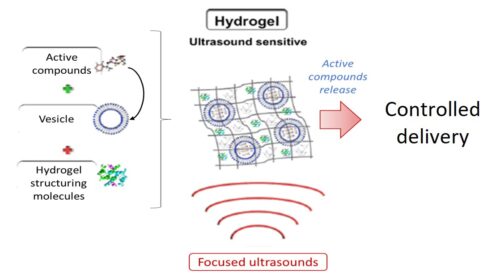
- Microfluidic encapsulation process of active ingredients in liposomes for their controlled differential release in time and space using ultrasound: the vesicles can be opened and then reclosed when the pulse stops.
- These vectors can be administered intravenously or incorporated into a hydrogel for topical application.
- The carrier may consist of a double emulsion, either hydrophilic and/or hydrophobic.
- Low-frequency ultrasound is used, featuring an innovative mechanism that destabilizes the electrostatic interactions within the hydrogel network.
- No cavitation or overheating occurs, which could otherwise damage tissues.
Market
- Two versions: for topical use (patch or dressing) and for intravenous use.
- Active ingredients: growth factors, antibiotics, drugs, hyaluronic acid, etc.
- Potential applications: rheumatology, dermatology, oncology, cosmetics, diabetology, physiotherapy.
Development status
- US Droplet : encapsulation of fluorescent probes in double emulsions subjected to ultrasound treatment (7 min, duty cycles 5–50%) shows that molecule release increases proportionally with treatment intensity
- Sonophoresis: encapsulation of BSA in alginate gels treated with focused ultrasound (5%, 20–60 min) results in protein release correlated with exposure time, despite only ~2% of the volume being directly exposed.
IP
- Patent application filed on December 16, 2022 (WO2024/126605) – CN, KR, US, JP, EP.
- Patent application filed on June 21, 2021 (WO2022/268284) – US, EP.
Valorisation strategy
- Licensing